Guest blog post by José Daniel Conejeros and Magdalena Gatsch on their experience organizing the “Abre Tu Ciencia” workshop (ATC 2026) in Chile January 21–23, 2026.
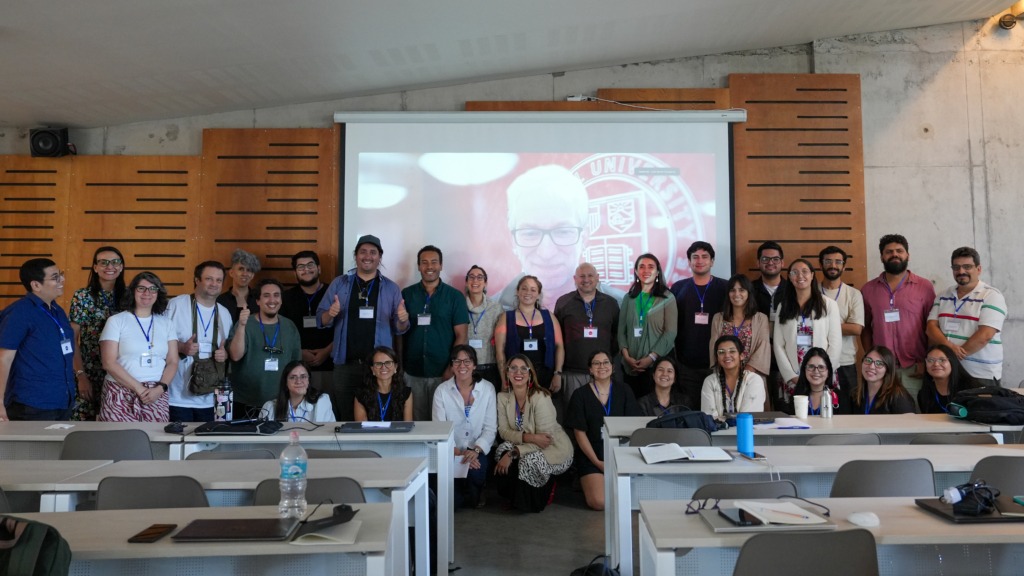
In January 2026, we organized the “Abre Tu Ciencia” workshop (ATC 2026) in Chile, thanks to support from a BITSS Catalyst Grant. The workshop brought together 60 researchers at different career stages, from different disciplines and interests, with the goal of learning about open science: pre-registration, reproducible workflows in R, good open data practices, and so on. We want to share with the open science community our reflections on what it means to sustain open science in the region, and what the current moment, one in which AI is opening up new opportunities and challenges in scientific practice, tells us.
The conversations among workshop participants confirmed something we have seen in other spaces across the region: Latin American researchers tend to arrive at open science first through the technical route (programming tools, Git, version control, etc.) rather than through the epistemic route, that is, understanding why pre-registration and the distinction between confirmatory and exploratory analyses matter for the validity of what is produced. This reverses the usual order seen in the Global North, where institutional scaffolding (agencies that require data management plans, journals with verification policies) has tended to push culture first and tools second. In the Latin American region, it happens the other way around; the tool is available, but the institutional culture that sustains it is not yet there.
The workshop’s overall assessment confirmed that this gap between tool and culture is not resolved by isolated events. On one hand, it became clear that the relationship between AI and open science needs to be explored in much greater depth, because the potential of these tools to accelerate, and also to distort, research workflows is too great to treat superficially. On the other hand, something we already suspected was confirmed: without a community of researchers committed to open science that sustains itself over time, building networks and collaborations, it is difficult for the field to advance and for knowledge and good practices to circulate beyond a single event. Behind both observations lies a third, more structural one: greater financial and institutional support is needed to sustain research, outreach, and capacity-building activities, as well as to generate evidence and practical initiatives that help institutions in the region transition toward an open science paradigm.
Taken together, these observations point to the same problem: open science in the region still lacks the institutional, human, and financial infrastructure that is taken for granted in the Global North. And it is precisely that infrastructure which is indispensable for responding to the challenges AI is introducing into open science. How do we integrate AI into our workflows without losing the ability to verify what we produce?
Provision and verification are not the same thing
To think through this question more carefully, Lars Vilhuber’s talk (Cornell University) at the workshop shed light on a distinction between two practices that are frequently conflated: provision of materials (publishing data and code) and verification (re-running the analysis and confirming that the same results are obtained). Provision favors transparency, but it is verification that compensates for the lack of trust between whoever produces the research and whoever reads it, and that distinction in turn exposes the deeper problem of data provenance and generation.
Vilhuber illustrates this with a simple example: if a researcher uses S&P 500 index data, the file comes from a trustworthy source, but the researcher cannot redistribute it due to licensing restrictions, so the weak link becomes whoever obtained the file. How can anyone else verify that it is the correct file without being able to access that same copy? A partial solution, already used in some workflows, is to publish the file’s checksum, a digital fingerprint that allows one to confirm that two copies are identical. This problem becomes more urgent, not less, as pressure grows to publish quickly and to synthesize literature with the help of AI — the same tension our workshop’s assessment raised.
Vilhuber also reviewed cases where computational verification was not enough because the manipulation occurred before the code ever started running. In the case of Dirk Smeesters (Erasmus University), an institutional investigation found statistically improbable results and a pattern of data selection incompatible with accepted scientific practices, while in the case of Francesca Gino (Harvard Business School, whose own research focuses on honesty), the site Data Colada identified manipulated data after collection and before analysis. In both cases, someone could have “reproduced” the analysis using the published code and arrived at the same results, because the problem was not in the code but in the data. Computational reproducibility is necessary but not sufficient; provenance verification is also needed, and that depends almost always on other humans carefully examining the work.
The Toner-Rodgers case and “research-grade” AI
These two cases precede and help explain the episode that today best illustrates the risks of incorporating AI into research without first resolving the provenance problem. The study by Aidan Toner-Rodgers, at the time a PhD student at MIT, on AI applied to materials discovery circulated widely, to the point of being cited by the President of the European Central Bank as evidence that AI-assisted researchers discover more materials and generate more patents. However, after a third-party review, MIT stated it had no confidence in the provenance, reliability, or validity of the data, nor in the veracity of the research (see more on the misconduct case here). The paper was withdrawn from the preprint repository, and it was not possible to independently verify either the origin of the data or the existence of the described experimental process.
What matters here is not simply that this was one more case of fraud, but that it was uncovered through third-party scrutiny of the coherence of the paper and its sources, not through computational reproducibility of the analysis, which did not look suspicious. That scrutiny came only after the result had already been used as evidence in a high-level economic policy forum. This connects to a warning in a recent BITSS article about “research-grade” AI: if we use AI to synthesize and accelerate scientific production without first resolving how to verify the quality and provenance of what feeds it, we risk scaling this same type of error, much faster and with fewer tools to detect it.
What this means for the Global South
The scrutiny that uncovered the Toner-Rodgers case required the painstaking work of researchers with the time, reputation, and platforms to do it, exactly the resources that the workshop’s assessment identified as scarce in the region. This raises the question of what happens, then, with research produced in or about Latin America, which rarely receives that level of external review. If the AI models used today to synthesize literature learn mostly from Global North output, and a large share of Latin American output is left out for not being indexed, reproducible, or written in English, research-oriented AI systems risk systematically rendering the region’s knowledge invisible. This is not merely a data bias problem: it is a problem of who is included in, and who is excluded from, the epistemic infrastructure on which these models are trained.
There is also an asymmetry in verification capacity that brings us back to the lack of funding and sustained community discussed earlier. Institutions such as the American Economic Association already have dedicated teams (the AEA Data Editor) that have verified a range of articles, and emerging initiatives exist, such as Transparency Certified, in which Vilhuber himself participates alongside CASCAD and INEXDA, that seek to externally certify data provenance through catalogs and checksums. Virtually no Latin American institution currently has equivalent capacity. Recent cases show that even in the Global North, this verification infrastructure has limitations. Even so, they also show that institutional mechanisms exist that are capable of detecting these problems and subjecting them to public scrutiny — mechanisms that remain far less common in Latin America.
Skepticism as an opportunity for the Global South?
Faced with this scenario, the Global South’s position need not be purely defensive. If we are going to adopt, and we are already adopting, AI in research either way, it is possible to demand from the outset what the North is only now learning, after cases like Toner-Rodgers’s: always keep a human verifying the process, document with precision every source and every step where a model intervenes, and systematically distrust results that cannot be independently verified, no matter how impressive they appear or who cites them.
That methodical skepticism about the provenance of evidence is, perhaps, the most important habit open science has to offer the age of AI. It is also, at bottom, what the workshop’s assessment asks us to build with more community and more funding: not a patch applied afterward, but a discipline built in from the design stage. That discipline could be the specific contribution Latin American research makes to this global conversation.