This post was written by Celine Tsoi, Laura Elizabeth Moreno-Gama, Shangcheng Zhao, Ph.D. students and co-chairs at ReproducibiliTea at UC Santa Barbara.
I attended the Berkeley Initiative for Transparency in the Social Sciences’ (BITSS) Research Transparency and Reproducibility Training (RT2) a year ago in 2025. Not only did I walk away with theoretical and practical open science knowledge, but I gained an invaluable colleague: Laura Elizabeth Moreno-Gama. Laura and I shared a collective delusion that we can make something like RT2 happen at our institution—UC Santa Barbara. Fortunately, we did not need to start from scratch. We already have ReproducibiliTea Journal Club and Open Science Librarians on campus. We, however, wanted to offer something catered towards graduate students specifically and across a wide range of disciplines, so we can all learn from each other. So, Laura, Shangcheng Zhao (a ReproducibiliTea member), and I set out to create our own Workshop Series. – Celine Tsoi
Applying our Knowledge: What It Takes To Start Something
We were worried about so many things—the first one of all—if we can get funding. We knew about BITSS’ Catalyst Grant, and we were so fortunate to have received an award. This was especially important to us because we did not want to reach out to potential speakers if the plans were going to fall through. The endorsement of BITSS propelled our plans forward. The only “downside” of the award was that now we actually had to see it through… so we got to work!
We then compiled a list of potential speakers. Our team of three comes from two departments, so while we know of open science experts of our field, we had to ask around to find other advocates from other departments. We were anxious about asking these experts about participating in our first-ever workshop, but we were pleasantly surprised by people’s enthusiasm, and it did not take long for us to have a full roster of speakers.
After finalizing our campus venue and catering, our main challenge was advertising. The responses came in slow at first, sitting at around 20 for a month or so. We were able to increase it to around 40 simply by emailing all relevant department administrators. Our campus librarians helped us reach the final 72-participant-limit by sending our event out to staff and faculty listservs that we do not have access to. The moment we received 72+ sign-ups, the team was ecstatic!
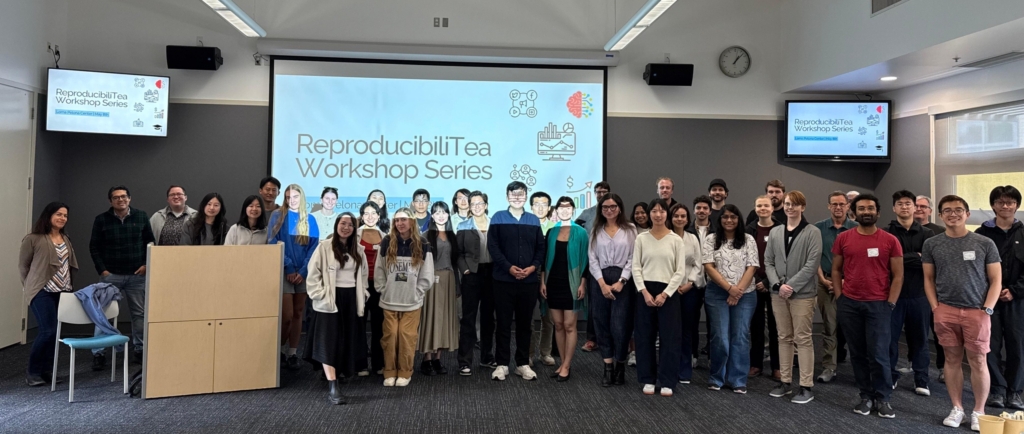
Our final group of 77 participants came from 16 different departments, and included exceptional undergraduates, graduate students, post-docs, staff, and faculty members. Our workshop included both theoretical and practical content that included study designs, Bayesian statistics, ethics and positionality, and institutional resources.
Evaluating Outcomes: Lessons Learned
We learned a lot from running our first workshop. Here is what we would do differently or what we would do similarly the next time around.
Topics: Participants expressed interest in discussions of preregistrations for megastudies, as well as walkthroughs of conducting meta-analyses or replications. We also heard clearly from participants that they needed more time in between talks to rest. We originally budgeted five minutes after each talk, but speakers tended to run overtime, so we should have 1) been more strict about time limits, and 2) budgeted more time for breaks. In the future, we might also get a big clock for the speakers to look at so they can do some timekeeping themselves as well.
Logistics: Spending a decent amount of money on food was a very good idea. Participants loved the food, and we did have most people show up around lunchtime. The venue we chose was also convenient. It had a built-in A/V system, along with good infrastructure for Zoom recordings with pre-mounted cameras, which made recording and eventual dissemination relatively easy.
New Additions: One thing we were proud of was our merchandise. We made a couple of stickers and one in particular—a racoon celebrating finding p < .05 in the trash—was especially popular, and it brought out some chuckles. We were also a small team of three. It was a small enough group to avoid collective action problems, but the workload was just barely manageable for us. Having a bit more help, maybe one to two more people, could work a bit better.
Beyond The Classroom: Next Steps to Build a Legacy
We were so fortunate to have received funding from BITSS for this event. We put so much effort into the workshop because we were not sure if we are able to do this again—so might as well go all out! With a larger community for open science, we feel more confidence in hosting regular meetings again, and if funding is still available for next year, we can do another workshop! We have also gained other potential collaborators, namely our campus librarians, who have been doing innovative open science programs for undergraduates.
In the long term, we hope to formalize open science education, perhaps through a certificate program for graduate students. This is something that the campus library has been planning to do, and UC Santa Barbara seems to offer certificate programs every now and then for both undergraduate and graduate students. While our team has expertise in the social sciences, the library is trying to encapsulate all research areas in their open research education. Partnering with more established institutions like the library can not only facilitate conversations across disciplines, but also lend credibility and infrastructure that a small graduate student team simply cannot build alone. Eventually, we aim to build something on campus that outlasts us, and this workshop, even if it just breathes a little bit of life in the open science climate on campus, is a great start.